Travel & Connectivity • Reading time: 1-2 minutes
The freedom of the digital nomad lifestyle is unparalleled. In 2026, the world is more connected than ever, allowing you to work from a cafe in Lisbon one week and a co-working space in Bali the next.
However, this freedom comes with a significant, often overlooked price tag: your digital privacy. As a location-independent professional, your data is constantly in transit across unfamiliar networks.
The sad reality of the 2026 digital landscape is that cyber threats have become highly sophisticated, often driven by AI, making the simple antivirus software of the past insufficient.
If you are serious about protecting your client data, your financial assets, and your personal identity while traveling, you need a robust toolkit. Relying on luck when connecting to airport Wi-Fi is no longer an option.
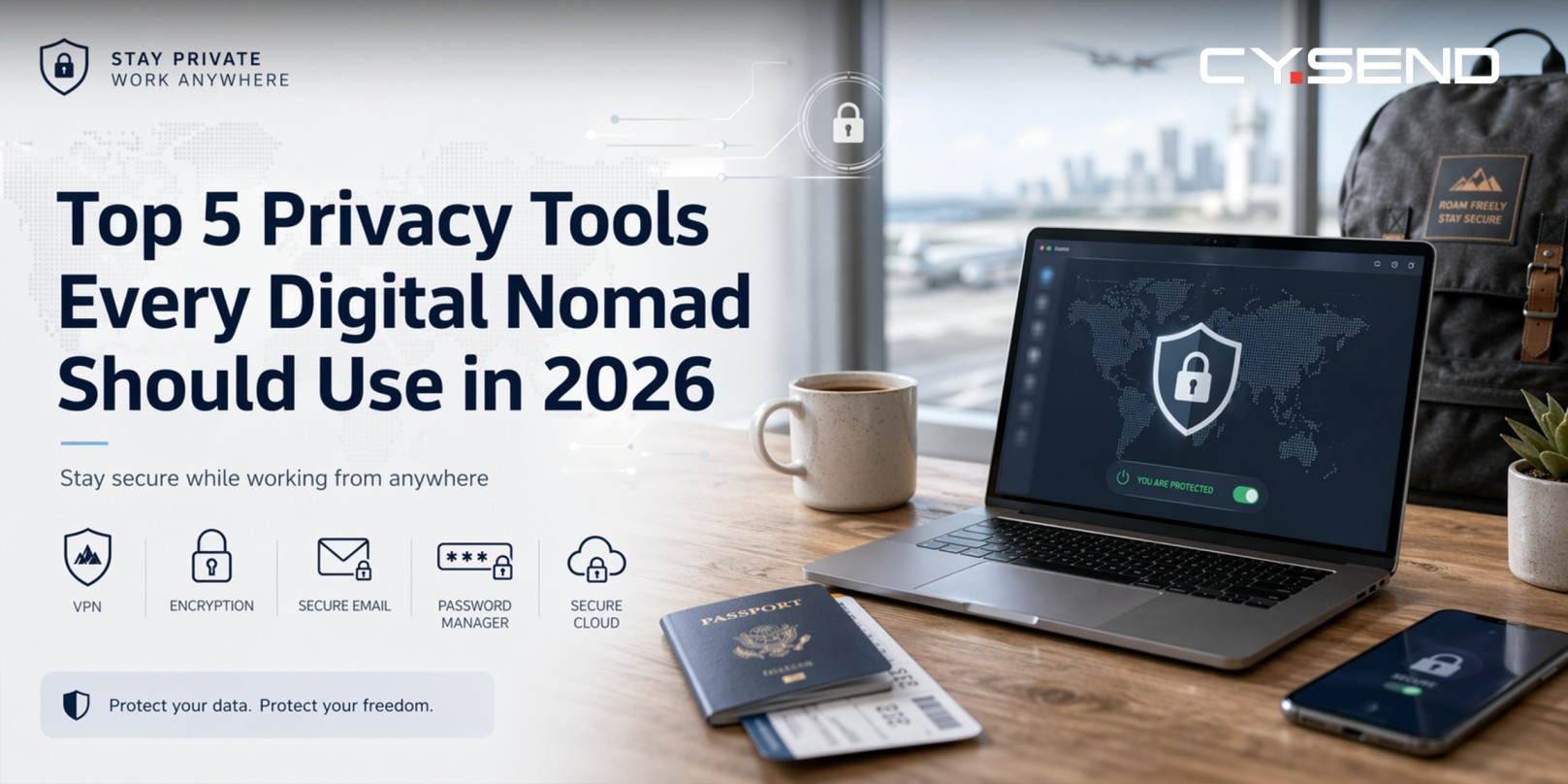
This guide goes beyond the basics. We have compiled essential strategies and nomad privacy tools designed to keep you secure in the evolving digital landscape of 2026. Let’s secure your digital freedom.
The evolution of digital threats for nomads in 2026
The evolution of digital threats for nomads in 2026
Before diving into the tools, it is crucial to understand the environment we are operating in. By 2026, the "surveillance economy" has only intensified.
Data brokers are more aggressive, and government surveillance in many popular nomad hubs has increased. Cybercriminals are no longer just lone wolves; they use automated tools to scan public networks for vulnerabilities. According to the IBM Cost of a Data Breach Report, the average cost of a data breach reached $4.45 million globally (), highlighting how valuable and targeted personal and business data has become.
The risks aren't just about someone stealing your credit card number; they are about identity theft, corporate espionage, and ransomware attacks targeting remote workers.
A digital nomad without the right privacy tools is effectively walking through a crowded market with their wallet taped to their forehead. Your defense strategy must be proactive, not reactive.
Next-generation virtual private networks (VPNs)
A VPN remains the cornerstone of any digital nomad’s security setup, but by 2026, not all VPNs are created equal. Basic encryption is now the bare minimum requirement.
When choosing nomad privacy tools, look for providers that offer "obfuscated servers" designed to bypass heavy censorship firewalls found in certain countries. A strong example is Proton VPN, which combines advanced privacy features with a strict no-logs policy.
Furthermore, look for VPNs that have moved to RAM-only server infrastructure. This means that even if a server is physically seized, there is no data stored on it to hand over.
Never rely on "free" VPNs for serious work. If you aren't paying for the product, your data is likely the product being sold to third-party advertisers.
Privacy-first browsing and search
Your web browser is your primary window to the digital world. Unfortunately, standard browsers are designed to leak data like a sieve, tracking your history and location for advertisers.
To regain control, you must switch to privacy-focused browsers. These tools come pre-configured to block third-party trackers, fingerprinting scripts, and invasive ads.
Pair your secure browser with a private search engine. Standard search engines record every query you make, tying it to your IP address and personal profile.
Privacy-centric search engines deliver results without recording your search history, ensuring your intellectual curiosity remains private no matter where you are in the world.
Secure financial transactions on the go
Managing finances across borders is a major challenge. Using your primary debit card for every small transaction—from local tours to coffee—exposes your main bank account to fraud. Understanding how to avoid fraud in international digital payments is essential when managing money across borders.
In 2026, smart nomads are decoupling their daily spending from their core assets. This is a critical aspect of financial privacy and security.
One effective strategy is using prepaid solutions and digital gift cards for everyday purchases. If you want to go deeper, learn more about safe online shopping with gift cards and how to minimize risks when paying online.
This is where services like CY.SEND become an integral part of your privacy toolkit. If you want to understand how the platform protects your transactions, check the security FAQs on CY.SEND. By allowing you to purchase gift cards for global brands securely, CY.SEND helps you minimize financial exposure.
You can use these prepaid options for rideshares, bookings, or local e-commerce without ever entering your main credit card number on a potentially insecure local website.
Encrypted communication platforms
As a digital nomad, you rely heavily on messaging apps to stay in touch with clients and family. However, standard SMS and many popular apps are far from secure.
For sensitive conversations involving client details or personal matters, you must use end-to-end encrypted (E2EE) messaging apps. E2EE ensures that only you and the recipient can read the messages.
In 2026, the best nomad privacy tools for communication also minimize metadata collection. They don't just protect what you say, but also hide who you are talking to.
The fortress: Password managers and 2FA
If you are still using the same password for multiple accounts, you are a prime target. The average nomad in 2026 manages dozens of accounts, from loyalty programs to banking apps.
A robust password manager is non-negotiable. These tools generate complex, unique passwords for every account and store them in an encrypted vault protected by a master password.
However, a password alone isn't enough. You must enable Two-Factor Authentication (2FA) on absolutely every account that supports it to add a second layer of defense.
Even if a hacker steals your password, they cannot access your account without the second factor, significantly reducing the risk of a total account takeover.
Secure cloud storage and data havens
Carrying sensitive data solely on your laptop's hard drive is a massive risk. Laptops get stolen, damaged, or seized at border crossings. You need a secure backup strategy.
Standard cloud storage providers often scan your files for data mining. For true privacy, you need end-to-end encrypted cloud storage where you hold the decryption key.
These services encrypt your files on your device before they are uploaded. This is essential for protecting client confidentiality and your own personal documents while living abroad.
Hardware security keys
For the ultimate level of account security, digital nomads in 2026 are turning to hardware security keys. These are small physical devices used as your second factor for authentication.
Unlike SMS codes, which can be intercepted via SIM swapping, a hardware key requires physical possession of the device to log in to your accounts.
Attaching a hardware key to your keychain ensures that even the most sophisticated hacker cannot access your critical accounts without physically stealing your keys.
Learn more about FIDO security standards
Disposable identities: Email aliases and virtual numbers
Every time you sign up for a hostel or cafe Wi-Fi, you are often asked for an email and phone number. This links your activities together, creating a profile of your movements.
To combat this, use disposable identities. Email aliases allow you to create a unique address for every service. If one is breached, you simply delete it without affecting your main inbox.
Similarly, virtual phone numbers allow you to receive SMS verifications without revealing your personal SIM card number. This separates your digital footprint from your physical identity.
Evaluating your privacy toolkit options
| Tool Category | Primary Benefit | Cost vs. Privacy Trade-off | 2026 Relevance |
|---|---|---|---|
| Premium VPN | Encrypts connection on public Wi-Fi. | Moderate Cost. High privacy return. | Critical for all travel. |
| Private Browser | Blocks trackers and fingerprinting. | Free. High privacy return. | Standard practice. |
| Prepaid Cards (via CY.SEND) | Decouples spending from bank accounts. | Low Cost. High transaction privacy. | Highly relevant for hygiene. |
| Encrypted Cloud | Protects data from providers. | Freemium. Worth the investment. | Essential for client data. |
| Hardware Security Key | Unphishable 2FA. | One-time Hardware Cost. | Recommended for critical accounts. |
Frequently asked questions (FAQ) about nomad privacy
1. Isn't using a VPN illegal in some countries?
In most of the world, VPNs are legal. However, some countries like China or the UAE restrict non-government-approved VPNs. Always research local laws before you arrive.
2. Can I just use the free Wi-Fi at my Airbnb?
You should treat Airbnb Wi-Fi as a public network. You don't know who has access to the router. Always use a VPN to ensure your connection is encrypted.
3. How does CY.SEND help with my privacy as a nomad?
CY.SEND allows you to purchase mobile top-ups and gift cards globally. By using these for daily expenses, you minimize the exposure of your primary banking information on local sites.
4. What should I do if my laptop is stolen while traveling?
If your hard drive is encrypted and you use strong passwords with 2FA, the thief cannot access your data. Use another device to remotely wipe your stolen laptop immediately.
5. Are password managers safe? What if they get hacked?
Reputable managers use zero-knowledge architecture. They encrypt data locally before it reaches their servers. Even if they are hacked, the attackers only get useless, encrypted gibberish.
6. Do I really need a hardware security key?
For your most critical accounts like primary email and banking, yes. In 2026, phishing attacks are very convincing. A hardware key removes the risk of being tricked into giving a code.
7. How can I receive 2FA SMS codes if I change SIM cards?
Relying on SMS for 2FA is difficult when traveling. It is better to switch to an authenticator app or a hardware key, which do not rely on a specific phone number.
8. What is a "burner" email address?
It is a secondary email used for low-trust sign-ups, like cafe Wi-Fi. It prevents your primary email from being clogged with spam or linked to your location history.
9. Is encrypted cloud storage slower than regular storage?
Sometimes, yes. Because encryption happens on your device, it can take slightly longer to upload files. This is a worthwhile trade-off for the security of your data.
10. How often should I update my privacy tools?
Set them to auto-update. Security software is constantly patched to fix new vulnerabilities. Using outdated software is a major security risk for any digital nomad.
How to protect your privacy as a digital nomad in 2026
The digital nomad lifestyle offers incredible freedom, but in 2026, that freedom requires vigilance. The digital landscape is fraught with risks that target the unprepared traveler.
By adopting these strategies and utilizing the right tools—from robust VPNs to smart financial solutions like those offered by CY.SEND—you can build a digital fortress around your data.
Don't wait until you experience a breach to take action. Start building your privacy toolkit today so you can focus on what really matters: exploring the world and doing great work.