Mobile connectivity in Europe: all you need to know about SIM card regulations
The landscape of mobile connectivity across Europe is undergoing a profound regulatory transformation that fundamentally changes how international travelers, expatriates, and digital nomads access cellular networks. For over a decade, the convenience of landing in a European destination, walking up to a local kiosk, and purchasing a prepaid Subscriber Identity Module (SIM) card without disclosing personal details was a staple of hassle-free travel. However, a sweeping legislative shift focused on national security, anti-fraud measures, and digital traceability is rapidly bringing an end to the era of anonymous mobile communication. Countries across the continent are systematically closing loopholes that previously allowed individuals to acquire and activate prepaid mobile services without verified identification.
This structural evolution creates a complex web of compliance requirements that vary significantly from one jurisdiction to another, catching many global professionals and tourists unprepared. As nations implement stringent Know Your Customer (KYC) protocols for telecommunications, understanding the legal framework governing mobile connectivity has become just as essential as checking visa requirements or currency exchange rates before departure. The operational friction resulting from these identity verification laws does not merely affect individual privacy; it directly impacts the ability of international business travelers to maintain seamless communication channels, coordinate logistical operations, and access critical data infrastructure upon arrival in a new territory.
The shift toward mandatory SIM registration in Europe
The transition from completely open, anonymous prepaid mobile networks to strictly monitored, identity-linked telecommunications ecosystems across Europe is driven by coordinated regional strategies and individual national mandates. Historically, the European Union has encouraged member states to strengthen their security frameworks, pointing to the exploitation of unregistered prepaid burner phones by criminal enterprises and syndicated networks as a primary vulnerability. While there is no single, omnibus European Union directive that universally dictates the exact operational mechanics of SIM card registration, a clear consensus has emerged among European regulatory bodies, including the Body of European Regulators for Electronic Communications (BEREC).
By the conclusion of 2024, and progressing rapidly through 2025 into 2026, nations that previously stood as holdouts for anonymous prepaid services have capitulated to pressure for enhanced regulatory oversight. Regulatory authorities in Eastern European corridors, alongside long-standing Mediterranean hubs, have systematically overhauled their telecommunications acts. The primary objective articulated by these governments is the creation of an unbreakable digital audit trail connecting every active International Mobile Subscriber Identity (IMSI) number to a verified human entity or legally registered corporate entity. This shift effectively eliminates the market for over-the-counter, unverified prepaid voice and data packages.
Why anonymous SIM cards are disappearing
The philosophical and regulatory justification for eradicating anonymous SIM cards is anchored almost entirely in security optimization, counter-terrorism compliance, and the mitigation of advanced financial cybercrimes. Law enforcement agencies across Western and Central Europe have long advocated for comprehensive identity tracking, citing that anonymous communication channels severely impede tactical investigations and predictive threat assessments. When a mobile device cannot be mapped to an identity, tracking fraudulent transactions, phishing networks, and extortion rings becomes exponentially more resource-intensive.
Furthermore, the rise of digital financial services, mobile banking apps, and two-factor authentication (2FA) mechanisms has inadvertently turned mobile phone numbers into primary security keys. Because a phone number is frequently used to verify corporate identities, authorize bank wires, and reset enterprise passwords, an anonymous SIM card presents a significant loophole for identity theft and SIM-swapping fraud. By legally requiring telecommunications operators to validate the passport, national identity card, or biometric profile of every subscriber before activating network privileges, European regulators aim to establish a more resilient, trustworthy digital environment that protects both state infrastructure and corporate enterprise data assets.
Recent changes: from Eastern Europe to EU-wide proposals
Examining the precise legislative timeline reveals that the contraction of anonymous spaces is happening at an accelerated pace. Up until recently, a small handful of European nations allowed the purchase of prepaid SIM cards with minimal to no identification. However, legislative amendments enacted between 2024 and 2026 have altered this paradigm. For instance, Poland and Germany have long enforced rigid identification verification checks, requiring either in-person passport presentation or post-office verification (Postident). More recently, nations in Eastern Europe, including Baltic authorities and neighboring Baltic states, have introduced legislative updates explicitly aimed at phasing out unverified prepaid accounts to align with regional security standards.
Similarly, intensive parliamentary debates and regulatory reviews within countries like Romania and Moldova have focused heavily on eliminating identity verification gaps. Telecommunications providers in these regions are now legally mandated to update their subscriber databases, forcing existing anonymous users to retroactively register their details or face immediate service suspension. Concurrently, European-level committees continue to discuss broader framework proposals aimed at standardizing KYC data collection methodologies across all member states. This initiative would facilitate cross-border data verification and eliminate regulatory arbitrage, where an individual might purchase a SIM card in a more lenient European jurisdiction to circumvent the strict identity verification requirements of their primary country of residence.
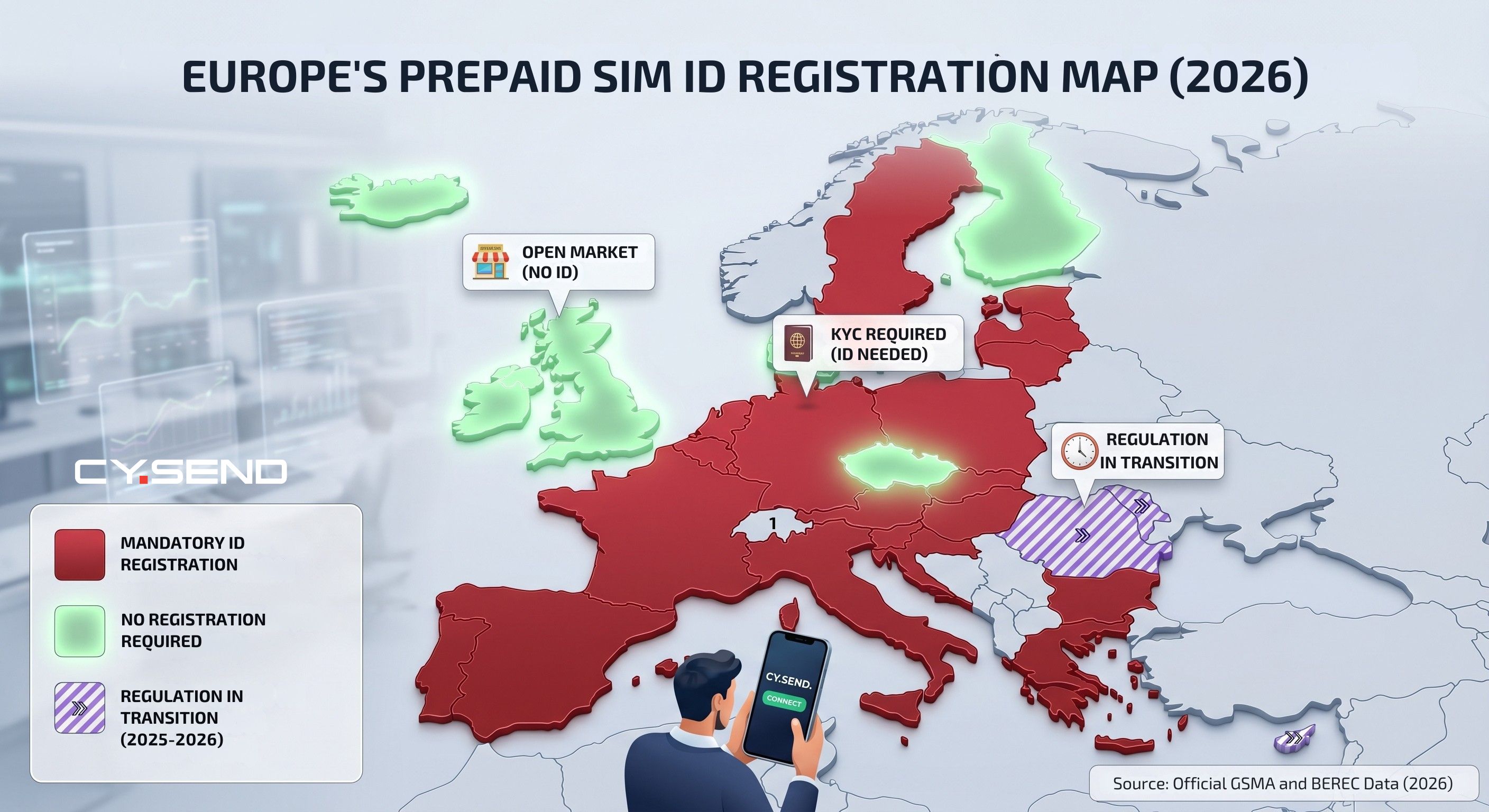 1 Switzerland requires mandatory registration of the SIM according to national legislation, but is excluded from the BEREC EU-specific data context.
How telecom regulations impact international travelers and expats
For the modern international consultant, corporate executive, or expatriate relocating to a European business hub, these evolving telecommunications regulations introduce tangible operational friction and logistical hurdles. The immediate consequence of mandatory registration laws is the total elimination of instant, friction-free mobile onboarding. A traveler can no longer rely on purchasing a temporary SIM card at an airport convenience store or transit station and expecting instant network access. Instead, the procurement process is now intertwined with administrative and bureaucratic verifications that require patience, specific documentation, and adherence to localized retail protocols.
This operational friction is particularly acute for individuals traveling from non-European Union countries. While a European citizen can frequently use a standardized national identity card to satisfy KYC requirements across various member states, non-EU nationals are universally required to present physical, valid international passports. This reality exposes travelers to extended wait times at physical carrier brick-and-mortar storefronts, potential language barriers with retail staff attempting to manually transcribe foreign passport data into localized telecom databases, and unexpected delays in activation times, which can stretch from a few minutes to several business days depending on the operator's verification queue.
The ID verification obstacle at point of sale
The physical point of sale has transformed from a simple commercial transaction counter into a regulatory compliance checkpoint. When an international traveler attempts to purchase a prepaid SIM card in countries such as Spain, Italy, France, or Germany, the retail agent is legally obligated to utilize a dedicated electronic terminal linked directly to the telecommunications company’s central compliance database. The process involves physically scanning the biometric page of the traveler's passport, capturing the document's cryptographic security zones, and occasionally executing real-time verification checks to ensure the document has not been reported lost, stolen, or fraudulent.
This rigorous process introduces several points of failure for the unsuspecting business traveler. If the retail location lacks the specialized scanning technology, if the internet connection to the central regulatory database experiences a temporary outage, or if the store clerk is insufficiently trained in processing international, non-EU documentation, the entire transaction is halted. Furthermore, many localized telecommunications operators restrict prepaid activations exclusively to individuals who possess a local tax identification number or a verifiable residential address within that specific country. This operational policy effectively locks short-term business travelers and tourists out of premium local network tiers, forcing them to navigate complex alternative channels or settle for substandard connectivity solutions.
Data privacy vs. instant connectivity
The enforceability of mandatory SIM card registration forces a direct confrontation between the fundamental human desire for data privacy and the practical necessity for instant, high-speed mobile connectivity. In an era characterized by large-scale corporate data breaches, state-sponsored surveillance apprehensions, and aggressive digital tracking, many privacy-conscious professionals are deeply uncomfortable with handing over highly sensitive passport data to third-party telecommunications retailers or local franchise operators. Once a passport is scanned into a commercial database, the subscriber loses direct oversight regarding how that data is stored, processed, or potentially shared among corporate subsidiaries and law enforcement entities.
This dilemma leaves international operators and enterprise travelers caught in a difficult position. On one hand, maintaining a completely private digital footprint while operating on European cellular networks has become functionally impossible through standard commercial channels. On the other hand, refusing to comply with identity verification demands results in immediate digital isolation—preventing access to maps, ride-sharing applications, corporate communication platforms like Slack or Microsoft Teams, and secure remote corporate networks via Virtual Private Networks (VPNs). Consequently, users are forced to make a calculated compromise, balancing their personal data privacy parameters against the non-negotiable professional mandate to remain continuously connected and responsive across international time zones.
Smart solutions for seamless connectivity across borders
Navigating this highly regulated environment requires a strategic pivot away from traditional, localized physical acquisition methods toward modern, cloud-integrated digital alternatives. Fortunately, technological innovation in the telecommunications sector has evolved concurrently with these legislative changes, providing sophisticated workarounds that remain fully compliant with European laws while bypassing the physical friction of local retail point-of-sale systems. For enterprises managing distributed workforces and international consultants executing cross-border assignments, leveraging these advanced digital infrastructure options is critical to maintaining operational continuity and avoiding costly downtime.
The key to optimizing international mobile connectivity lies in separating the physical procurement of network access from the immediate geographical destination. By utilizing global roaming architectures, software-defined connectivity platforms, and centralized international top-up providers, corporate travelers can establish a robust, reliable communication framework long before they set foot on an international aircraft. These proactive mechanisms ensure that when a professional transitions from one jurisdiction to another, their mobile devices automatically negotiate network access with local roaming partners, thereby preserving connectivity without requiring a repetitive cycle of document submission, identity validation, and localized physical activation delays.
The digital alternative: pre-registered roaming & eSIMs
The primary technological catalyst redefining international connectivity is the rapid adoption of Embedded SIM (eSIM) technology. An eSIM replaces the traditional, removable plastic SIM card with a programmable chip embedded directly into the device's motherboard during manufacturing. This allows users to download network profiles over-the-air (OTA) via localized software applications or encrypted QR codes. From a regulatory perspective, eSIM profiles can be provisioned by international digital providers who aggregate global network access, allowing users to complete identity verification digitally through secure, automated application portals prior to commencing their travels.
Alternatively, utilizing a pre-registered, international roaming SIM card issued by a global provider operating outside the immediate restrictions of the destination country presents a viable operational pathway. Under existing international telecommunications treaties and roaming agreements, a SIM card legally registered and issued in an origin country can seamlessly roam onto European networks. Because the primary regulatory relationship remains tethered to the originating global carrier, the user is not subjected to the localized retail KYC checkpoints of the visited country. This strategy enables immediate, automated data access upon landing, utilizing premium local networks without interacting with local bureaucratic infrastructures or disclosing sensitive passport documentation to unfamiliar local retail entities.
Streamlining your experience with CY.SEND digital top-ups
For individuals and corporate enterprises managing existing prepaid mobile assets across multiple European and global jurisdictions, maintaining these connections without interruption is an ongoing administrative challenge. This is precisely where the centralized digital infrastructure of CY.SEND. becomes an indispensable asset in a professional's operational toolkit. As a premier global platform specializing in corporate rewards, digital gift cards, and international mobile top-ups, CY.SEND. provides a streamlined, secure environment designed to keep mobile connections continuously active, funded, and operational across international borders without bureaucratic friction.
Instead of navigating unfamiliar, localized telecommunications websites—which frequently reject international credit cards, require local language proficiency, or demand repeated identity verifications for basic financial transactions users can utilize CY.SEND. to instantly replenish airtime and data balances for thousands of mobile operators globally. The platform operates with maximum financial transparency and security compliance, allowing corporate managers to centrally fund and maintain the mobile connectivity assets of an entire international team from a single, unified interface. By ensuring that prepaid balances never lapse, CY.SEND. effectively prevents the automated account deactivations that local European carriers execute when a prepaid account remains dormant or un-funded for extended periods, preserving vital international communication lifelines.
Frequently asked questions (FAQ)
Can I still purchase a completely anonymous prepaid SIM card anywhere in Europe in 2026?
In many European countries, prepaid SIM cards require identity verification, especially when purchased from local mobile operators. However, rules are not fully harmonized across Europe, and requirements can vary by country, provider, and product type. Travelers should not assume anonymous prepaid SIM cards will be available and should check the rules for their destination before arrival.
What identification documents do non-EU citizens usually need to register a SIM card in Europe?
In countries where SIM registration is required, non-EU visitors are usually asked for a valid passport. Some providers may also request a local address, hotel address, or additional verification step. Requirements vary by country and operator, so it is best to check the provider’s instructions before purchase.
How do European SIM card registration laws affect international roaming for travelers?
If you use your existing mobile plan, an international roaming SIM, or a travel eSIM, you usually do not need to register with a local shop when you arrive. Your device connects through roaming agreements. However, the provider that issued the SIM or eSIM may still have its own identity, payment, or account-verification requirements.
Are there any European countries that do not require identity verification for prepaid mobile data?
Yes, some European markets may still have lighter or different rules, especially for certain prepaid or data-only products. The safest approach is to check the destination country and provider before traveling, because SIM registration rules are changing and are not the same across all of Europe. EU discussions in 2025 also show that policymakers are considering broader action on anonymous SIM use, but that does not mean a single EU-wide rule is already fully in place.
Can I register a European prepaid SIM card online before I arrive?
Sometimes. Many mobile operators and travel eSIM providers allow online purchase or activation before arrival, but the process depends on the country and provider. Some may ask for passport upload, video verification, or app-based identity checks, while some travel eSIM products may only require account and payment details. Always confirm the activation steps before buying.
What happens if I provide false information during SIM registration?
Do not provide false or altered information. If a provider detects incorrect or fraudulent details, the SIM may be blocked, suspended, or refused activation. Depending on the country and the nature of the false information, there may also be legal consequences.
How long does activation take after I submit my ID for SIM registration?
Activation time varies. Some prepaid SIMs or eSIMs activate within minutes after verification, while others may take longer if manual review is needed. To avoid stress, complete registration before you urgently need mobile data, especially if you are arriving late, traveling on a weekend, or depending on mobile connectivity for maps and transport.
Does mandatory SIM registration apply to digital data-only eSIM profiles?
It depends on the provider, country, and type of eSIM. Some data-only travel eSIMs can be purchased and installed without local passport verification, while local operators in countries with SIM registration rules may require identity checks even for eSIM activation. Check the product terms before buying.
How can CY.SEND help me manage international mobile connectivity needs?
CY.SEND can help travelers and international users buy mobile top-ups, prepaid data products, eSIM-related products, and other digital connectivity options where available. Product availability depends on the destination country, operator, and provider, so select the country first and review the product details before purchase.
Is my personal data safe when I register a SIM card with a European telecommunications company?
Telecommunications companies operating in the EU must follow GDPR rules when collecting, storing, and processing personal data. GDPR requires organizations to manage personal data securely and lawfully, but travelers should still buy from reputable providers, read privacy notices, and avoid sharing passport details through unofficial sellers or unsecured channels.
Stay connected without the bureaucracy
The definitive eradication of anonymous SIM cards across Europe represents a permanent structural shift in the global telecommunications matrix. As national governments prioritize absolute digital traceability and heightened security compliance, the traditional methods of securing mobile data while traveling are becoming obsolete. Attempting to manage mobile connectivity entirely on an ad-hoc, physical basis upon arrival in each new country is no longer a viable strategy for modern professionals who operate within fast-paced international frameworks where connectivity delays translate directly into lost revenue and operational vulnerability.
Embracing a sophisticated, digital-first approach to telecommunications management is the only definitive way to bypass local bureaucratic friction while remaining completely compliant with international law. By integrating advanced eSIM profiles, leveraging global roaming arrangements, and relying on centralized digital management utilities like CY.SEND. to maintain, fund, and optimize mobile communication assets, international travelers and enterprise operations can successfully insulate themselves from localized regulatory disruptions. In this heavily regulated era, proper forward planning and the utilization of trusted digital platforms ensure that your transition across borders remains smooth, your personal data remains protected, and your business operations remain continuously connected to the global digital economy.
 Chinese Simplified
 Italiano
 Português
 Türkçe